How to Read Food Labels on Keto: Net Carbs Without the Guesswork



I still remember standing in the supermarket aisle with two jars of tahini spread, turning them over like a detective. One said "no added sugar" in big friendly letters. The other said nothing at all. The quiet one had fewer carbs.
That was the day I stopped reading the front of the package and started reading the back. It took a few weeks of practice, and then it became a ten-second habit.
If labels feel like small print written for someone else, this guide is for you. We will walk through a label the way you would in the shop: what to look at first, how to work out net carbs, and where sugar likes to hide.
Key takeaways
- The front of the package is advertising. The nutrition table and the ingredient list on the back are the information.
- Check the serving size first. In Israel and Europe, values are shown per 100 g; many imported products show values per serving.
- Net carbs are the carbohydrates your body digests: total carbohydrates minus fiber. How to calculate them depends on how the label lists fiber.
- Ingredients are listed from the largest amount to the smallest. If a sugar or a starch is near the top, the product is mostly that.
- You do not need to be perfect. Reading a few labels a week is enough to build a good instinct.
Start with a real product, not with theory
Take something you already buy. A tub of cottage cheese, a jar of raw tahini, a bag of almonds. Turn it over. You will usually find three things: a nutrition table, an ingredient list and, sometimes, symbols on the front.
Most keto meals are built from foods that have no label at all: vegetables, eggs, fish, chicken, olive oil. That is good news. Labels matter mostly for the "helpers" around those foods: spreads, sauces, dairy, snacks, sausages and anything called "keto", "diet" or "protein".
So the goal is not to read everything. The goal is to read the five or ten packaged foods you eat every week, once, properly. If you prep your meals ahead, you already know which ones those are.
The nutrition table, line by line
Here is what each line tells you, and what I do with it.
| Line on the label | What it tells you | What to do with it |
|---|---|---|
| Serving size / per 100 g | The amount the numbers refer to | Compare it with the amount you really eat |
| Energy (calories) | Total energy | Good to know; no need to obsess |
| Fat, of which saturated | Total fat and its type | On keto, fat is a main energy source; notice the source |
| Carbohydrates | All digestible carbs, sometimes including fiber | The key line for keto |
| Of which sugars | Sugars inside the carb number | High sugar means the carbs are fast ones |
| Dietary fiber | Carbs your body does not digest | Used for the net carb calculation |
| Protein | Grams of protein | Helps you build a filling meal |
| Sodium | Salt content | Useful on keto, when many people need enough salt |
The serving size trap
A label can look wonderful when the "serving" is two crackers. Always ask: how much of this will I really eat? If the table is per 100 g and you eat a 30 g handful, you eat about a third of each number. If you eat the whole 250 g tub, multiply by two and a half.
How to work out net carbs
Net carbs are total carbohydrates minus fiber. Fiber is a carbohydrate, but the body does not break it down into sugar, so most keto eaters do not count it.
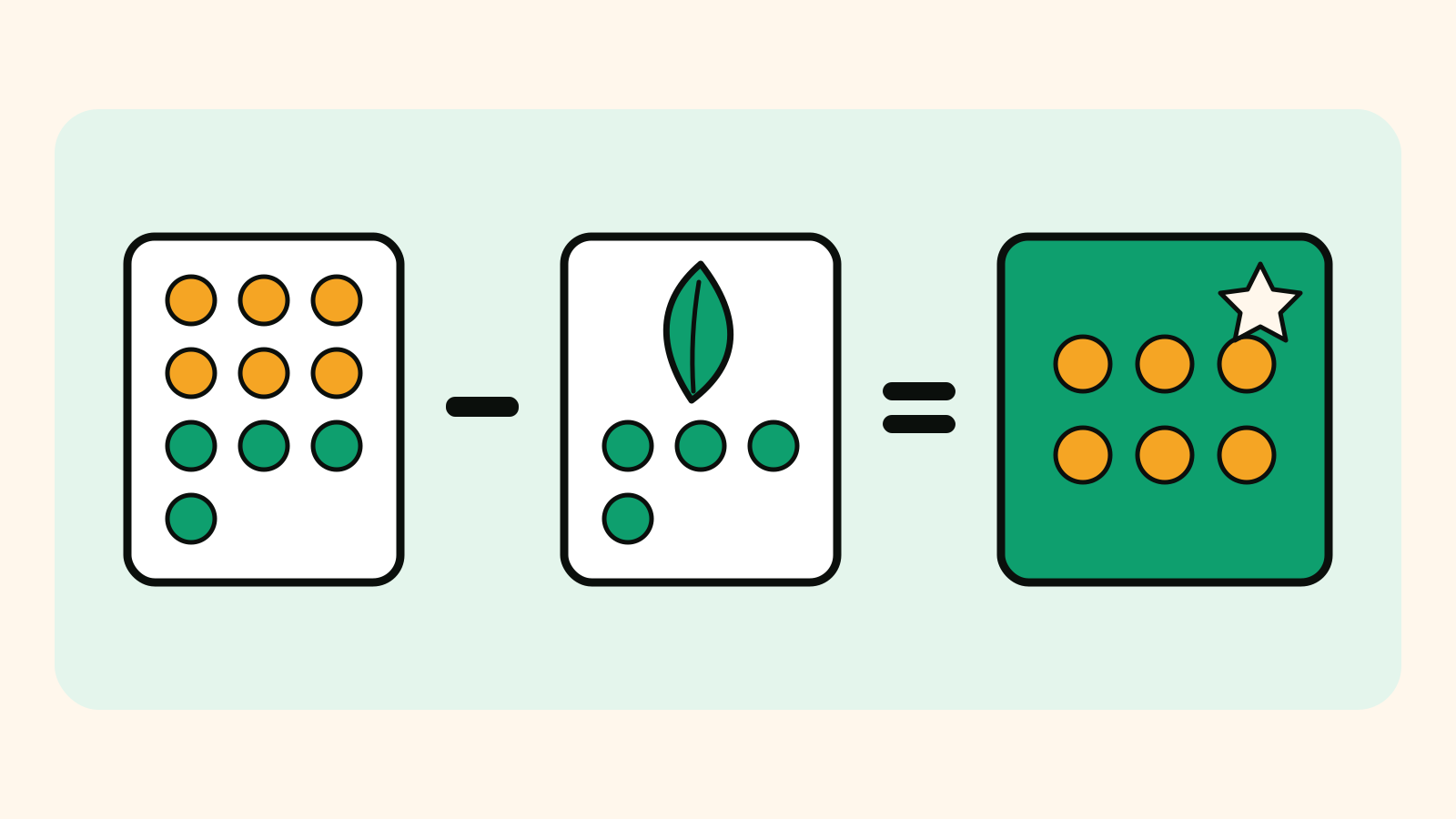
The tricky part is that labels around the world do this differently:
- American-style labels list "Total Carbohydrate" with fiber included in it. Here you subtract the fiber.
- European-style labels usually list carbohydrates without the fiber, and show fiber on its own line. Here the carbohydrate number is already close to net carbs, and you do not subtract again.
- Israeli labels show values per 100 g with fiber on a separate line. If you are not sure whether fiber is included, take the carbohydrate number as it is. It is the more careful choice.
A worked example
Say a bag of nuts shows, per 100 g: 20 g total carbohydrate, of which 12 g is fiber, on an American-style label.
- Find total carbohydrates: 20 g.
- Find fiber: 12 g.
- Subtract: 20 − 12 = 8 g net carbs per 100 g.
- Adjust for your portion: a 30 g handful is about 2.5 g net carbs.
- Log it and move on.
What about sugar alcohols?
Sweeteners such as erythritol, xylitol and maltitol are listed as polyols or sugar alcohols. They are digested only partly, and each one behaves differently. People also react differently, and larger amounts can upset the stomach. If a product depends heavily on them, treat the "net carb" claim on the front with some caution and see how you feel.
Approximate net carbs in everyday foods
These numbers are rough and vary between brands. They are here to train your eye, not to replace the label in your hand.
| Food | Typical serving | Net carbs (approx.) |
|---|---|---|
| Cottage cheese | 100 g | 3 g |
| Plain yogurt, unsweetened | 150 g cup | 6-7 g |
| Raw tahini | 1 tablespoon (15 g) | 1-2 g |
| Ready-made hummus | 2 tablespoons (30 g) | 2-3 g |
| Almonds | 30 g handful | 3 g |
| Dark chocolate, 85% cocoa | 2 squares (20 g) | 4 g |
| Fruit yogurt, sweetened | 150 g cup | 18-20 g |
| Granola bar, "no added sugar" | 1 bar (25 g) | 10-15 g |
Look at the last two rows. Both sound healthy, and both can use up most of a day's carbs on a strict keto plan. Tahini and hummus, on the other hand, fit nicely in sensible amounts, which is one reason the Israeli and Mediterranean table is so keto-friendly.
The ingredient list: where sugar hides
Ingredients are listed in descending order by weight. The first three tell you what the product mostly is.
Other names for sugar
Sugar rarely appears just as "sugar". Watch for:
- Glucose, fructose, dextrose, maltose, and syrups made from them
- Maltodextrin and modified starch
- Honey, date syrup (silan), agave and maple syrup
- Fruit juice concentrate
- Rice flour, corn flour and potato starch in "gluten-free" products
Natural does not mean low-carb. Silan and honey are lovely foods, and they are still sugar.
Front-of-pack claims
"No added sugar" means that no sugar was added. It does not mean the product is low in carbs: dates, fruit and flour bring plenty of their own. "Light", "diet" and "protein" also say nothing about carbs. "Keto" on a package is a marketing word, not a regulated promise. Turn the package over every time.
The red and green symbols in Israel
In Israel, packaged foods that are high in sugar, sodium or saturated fat carry a red symbol on the front. A green symbol marks foods that fit the Ministry of Health's recommendations. For keto shopping, the red sugar symbol is a fast, useful signal. The saturated fat and sodium symbols also appear on foods such as hard cheese and olives, so read them as information and talk to your doctor about what is right for you.
A ten-second routine for the shop
- Ignore the front of the package.
- Find the carbohydrates per 100 g.
- Check the fiber and work out the net carbs.
- Think about your real portion.
- Read the first three ingredients.
- Decide, and put it in the basket or back on the shelf. No guilt either way.
After a month you will know your regular products by heart, and you will only need this routine for new ones.
FAQ
What are net carbs?
Net carbs are the carbohydrates your body digests: total carbohydrates minus fiber. Many people on keto count net carbs instead of total carbs.
Do I subtract fiber on every label?
No. Subtract it when the carbohydrate number includes fiber, as on American-style labels. On European-style labels, the carbohydrate number usually leaves fiber out already.
Is "no added sugar" the same as low-carb?
No. A product can have no added sugar and still be high in carbs from fruit, dates, flour or milk. Check the carbohydrate line.
How many net carbs per day fit a keto diet?
Many keto plans use roughly 20 to 50 g of net carbs a day, but the right number varies by person. A doctor or dietitian can help you find yours.
Do I need to read labels forever?
Not really. Most of us buy the same products again and again, so after a few weeks you will only need to check new ones.
Sources
www.nia.nih.govwww.nia.nih.gov www.gov.ilwww.gov.ilThis article is general information, not medical advice. If you have a medical condition, are pregnant or take medication, ask your doctor before changing your diet.
This article is general information, not medical advice. Talk to your doctor before changing how you eat or fast, especially if you have a medical condition, are pregnant or take medication.

 By Luna Hayes
 By Remy Carmel